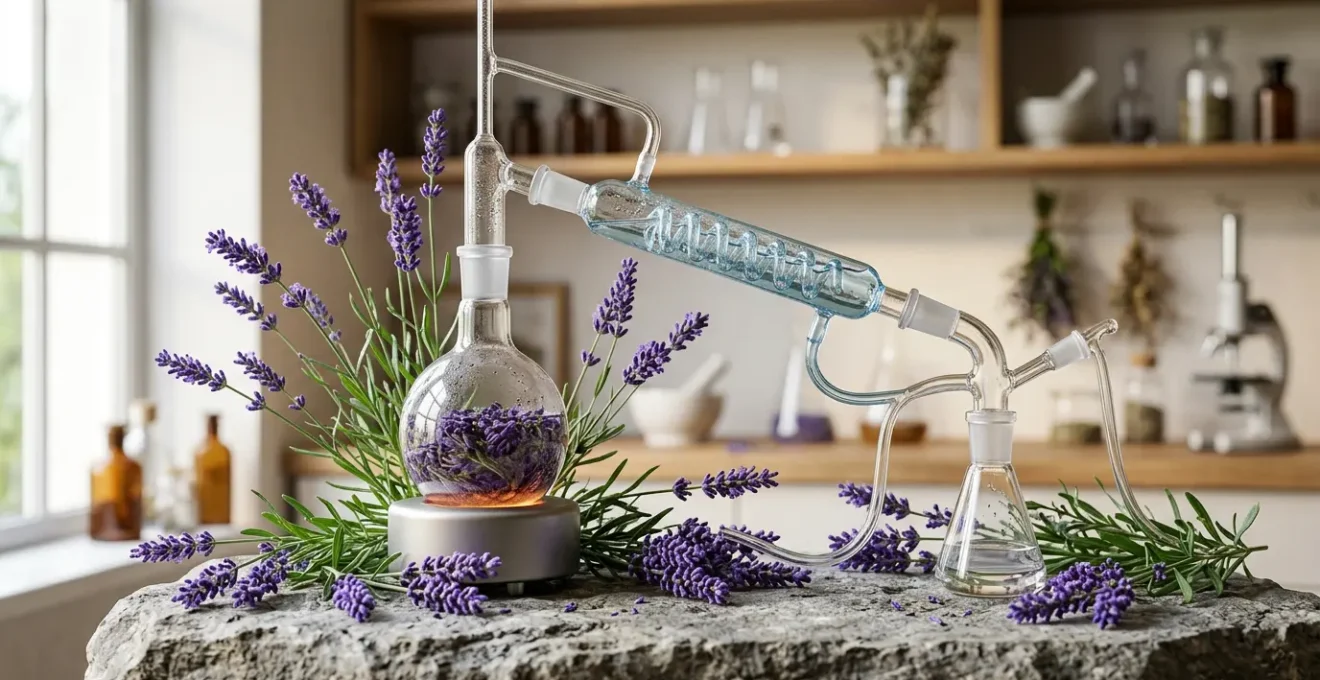
Reducing cortisol with aromatherapy isn’t about vague ‘calmness’; it’s a measurable biochemical process directly targeting the brain’s stress center.
- Inhalation allows specific molecules like linalool to bypass the digestive system and influence the amygdala in minutes.
- The therapeutic effect is entirely dependent on the oil’s purity, as adulterated products lack the necessary chemical constituents.
Recommendation: Prioritize oils with transparent GC-MS testing and use targeted application methods based on your goal, from rapid diffusion for panic to systemic topical use for background stress.
In our hyper-connected world, the feeling of being simultaneously “wired and tired” has become a baseline state for many. This chronic activation of the body’s stress response system, governed by the hormone cortisol, can lead to a cascade of negative health effects. While common advice often points toward practices like yoga or meditation, a powerful and often misunderstood tool lies in our most primitive sense: smell. Many people turn to essential oils for stress relief, but the conversation rarely moves beyond generic recommendations of “calming” scents.
The truth is, the ability of an essential oil to lower cortisol is not a matter of magic or placebo; it is a function of neurochemistry. The effect isn’t just about a pleasant aroma but about specific volatile organic compounds entering the nasal cavity and sending direct signals to the brain’s emotional core. This process is so immediate that it can bypass the cognitive loops that keep us trapped in a state of stress. However, this potent effect is contingent on two critical, non-negotiable factors: the molecular purity of the oil and the precise method of application.
This guide moves beyond the platitudes. We will dissect the scientific mechanisms that allow certain essential oils to measurably reduce cortisol levels. We will explore why inhalation can be more effective than oral supplements for acute stress, what makes an oil therapeutically viable, and the essential safety protocols you must follow. Finally, we will provide an actionable framework for integrating this knowledge into a practical, cortisol-lowering evening routine, empowering you to use aromatherapy as a targeted, evidence-based clinical tool.
This article provides a clinical breakdown of how aromatherapy works to modulate the body’s stress response. The following sections explore the science, safety, and practical application of using essential oils for cortisol management.
Contents: A Clinical Breakdown of Aromatherapy for Cortisol Reduction
- Why inhaling lavender oil impacts the amygdala faster than oral supplements?
- How to safely diffuse oils in a home with pets and children?
- Topical vs Diffusion: which method works best for panic attacks?
- The purity error: identifying synthetic adulterants in “100% natural” oils
- Office-friendly blends: scents that boost focus without annoying colleagues
- Adaptogens for stress: when to take Rhodiola vs Holy Basil?
- Why “catastrophizing” hijacks your logical brain during stress?
- How to Lower Cortisol Levels Naturally in the Evening?
Why Inhaling Lavender Oil Impacts the Amygdala Faster Than Oral Supplements?
The remarkable speed at which inhaled essential oils can affect our mood is not a psychological quirk; it’s a matter of neuro-anatomical wiring. When you inhale an essential oil, its volatile molecules travel up the nasal passages to the olfactory bulb. This structure is unique because it has a direct, super-highway connection to the core of the brain’s emotional center: the limbic system, which includes the amygdala and hippocampus. The amygdala is the primary mediator of our stress and fear responses, while the hippocampus is crucial for memory formation.
Unlike an oral supplement that must survive the digestive tract, be metabolized by the liver, and then cross the blood-brain barrier, inhaled aromatic compounds have a privileged, near-instantaneous access pass to the brain. This direct pathway is the key to their rapid anxiolytic (anti-anxiety) effects. Specific molecules within the oils, such as linalool and linalyl acetate abundant in true lavender (Lavandula angustifolia), are responsible for these effects by modulating neurotransmitter activity.
This direct stimulation allows aromatherapy to serve as a powerful “bottom-up” regulation tool, calming the emotional brain before the logical, thinking brain even has a chance to process the stressor. To visualize this incredible biological shortcut, the diagram below illustrates the pathway from scent to brain.
As the image suggests, this is an intricate and direct biological network. Indeed, neuroimaging research has shown significant activation in the amygdala, hippocampus, and other limbic structures within minutes of lavender inhalation, confirming its direct impact on the brain’s emotional and stress-processing centers. This explains why a simple inhalation can provide a sense of calm much faster than waiting for a capsule to take effect.
How to Safely Diffuse Oils in a Home with Pets and Children?
The very potency that makes essential oils effective also mandates a rigorous approach to safety, especially in households with vulnerable members like children and pets. Their smaller bodies and developing (or different) metabolic systems process these concentrated compounds differently. For children, the primary rules are dilution and secure storage. Never apply undiluted oils to a child’s skin, keep bottles far out of reach, and diffuse in a well-ventilated area for short periods.
When it comes to pets, particularly cats, the risks are significantly higher. Cats have a unique physiology that makes them highly sensitive to many essential oils. As veterinary research confirms, cats are deficient in the enzyme glucuronyl transferase, which is crucial for metabolizing many compounds, including phenols and terpenes found in oils like tea tree, pine, and citrus. This deficiency means the compounds can build up to toxic levels in their system.
To safely practice aromatherapy around pets, a proactive and cautious strategy is required. You must never apply essential oils directly to a pet’s skin or fur and should avoid using oils known to be toxic to them. For diffusion, always ensure the pet can freely leave the room and access fresh air. Use a water-based diffuser for short durations (15-30 minutes) in a large, well-ventilated space, and air out the room before allowing the pet to re-enter. Daily, prolonged diffusion is not recommended, as even safe oils can cause respiratory irritation over time. The goal is intermittent, intentional use, not constant saturation of the environment.
Topical vs Diffusion: Which Method Works Best for Panic Attacks?
The choice between topical application and diffusion is not a matter of preference but of clinical strategy, dependent on the specific goal. When addressing an acute event like a panic attack, the primary objective is to interrupt the neurological feedback loop as quickly as possible. In this scenario, inhalation via diffusion is the superior method.
A panic attack is an amygdala hijack in its most extreme form. The goal is to send an immediate, powerful calming signal directly to the limbic system. As we’ve discussed, inhalation provides the most direct pathway for this. The aromatic molecules bypass cognitive processing and directly modulate activity in the amygdala, helping to down-regulate the fight-or-flight response. For this purpose, diffusing an oil high in calming esters and monoterpene alcohols, like Lavender or Bergamot, can provide rapid relief.
Topical application, conversely, works through a different and slower mechanism. When applied to the skin (always diluted in a carrier oil like jojoba or fractionated coconut oil), the essential oil molecules are absorbed into the bloodstream. This creates a systemic, longer-lasting effect. This method is less effective for stopping a panic attack in the moment but is an excellent strategy for managing generalized, background anxiety throughout the day. By providing a low, steady dose of calming constituents to the body, topical application can help raise the threshold for stress and make one less susceptible to tipping into a panic state. Therefore, think of diffusion for acute intervention and topical use for chronic prevention.
The Purity Error: Identifying Synthetic Adulterants in “100% Natural” Oils
Perhaps the single most critical factor in therapeutic aromatherapy is one that is almost entirely overlooked by the average consumer: purity. An essential oil bottle labeled “100% Pure Lavender” means very little in an unregulated industry. The therapeutic effects discussed previously are tied to a complex synergy of hundreds of natural chemical constituents. Adulteration, the practice of adding synthetic compounds or cheaper oils, breaks this synergy and renders the oil ineffective at best and harmful at worst.
Adulteration is rampant because it is profitable. A synthetic version of linalool, for example, is far cheaper to produce than to extract from true lavender flowers. This issue is not a minor one; a comprehensive GC-MS analysis revealed that 75% of commercial lavender essential oil samples tested were adulterated. These oils may smell pleasant to an untrained nose but lack the precise molecular structure needed to interact with our neurochemistry correctly.
The only reliable way for a consumer to verify purity is to demand third-party testing transparency from brands. The gold standard is a Gas Chromatography-Mass Spectrometry (GC-MS) report. This analysis separates every single molecule in the oil and identifies it. A trustworthy company will provide batch-specific GC-MS reports for every oil they sell. When reviewing a report, you should see a chemical profile that matches the known profile for that botanical, with no synthetic markers or compounds from other plants. Without this proof, you are simply buying a fragrance, not a therapeutic tool.
Office-Friendly Blends: Scents That Boost Focus Without Annoying Colleagues
Using aromatherapy to manage stress and boost focus in a shared office environment presents a unique challenge: maximizing personal benefit while minimizing olfactory impact on others. Open-air diffusion is generally inconsiderate in this context. The solution lies in methods of personal, contained inhalation and choosing scents that are effective without being overpowering or commonly associated with “perfume.”
An excellent method for office use is a personal aromatherapy inhaler. This is a small tube containing a cotton wick that you can infuse with a few drops of essential oil. It allows you to uncap and inhale deeply whenever needed without the scent permeating the room. A simpler alternative is placing a single drop on a tissue or a terracotta pendant kept on your desk.
For the choice of oils, focus should be on those known to support cognitive function and reduce stress without being heavy or floral. Rosemary (Rosmarinus officinalis) is a clinical standout. Far from just a culinary herb, research on its aromatic compounds demonstrates that its inhalation can increase free radical scavenging activity and decrease cortisol levels. Its primary constituent, 1,8-cineole, is associated with enhanced memory and alertness. Other excellent choices are citrus oils like Lemon (Citrus limon) and Bergamot (Citrus bergamia), which have an uplifting effect, or Peppermint (Mentha piperita), which is clarifying and stimulating. These scents are generally perceived as “clean” and “fresh,” making them less likely to be disruptive to colleagues.
Adaptogens for Stress: When to Take Rhodiola vs Holy Basil?
While essential oils offer a rapid, neurologically-driven approach to stress management, another class of botanicals, known as adaptogens, provides a powerful systemic and hormonal approach. Adaptogens are herbs that work by modulating the Hypothalamic-Pituitary-Adrenal (HPA) axis—the body’s central stress response system. They help the body “adapt” to physical and emotional stress, enhancing resilience over time. While many adaptogens exist, choosing the right one depends on the specific nature of your stress symptoms.
Rhodiola (Rhodiola rosea) is best understood as a stimulating adaptogen. It is the ideal choice for individuals experiencing stress-induced fatigue and burnout. If you feel mentally foggy, physically exhausted, and have trouble concentrating due to chronic stress, Rhodiola can help improve energy levels and cognitive performance. It is best taken in the morning or early afternoon to avoid any potential interference with sleep.
Holy Basil (Ocimum sanctum), also known as Tulsi, operates on the other end of the spectrum. It is a calming and grounding adaptogen. Holy Basil is the superior choice for individuals whose stress manifests as anxiety, racing thoughts, and elevated cortisol levels, particularly in the evening. It helps to soothe the nervous system and promote a sense of tranquility without causing sedation. It can be taken in the afternoon or evening to help unwind from the day and prepare the body for restful sleep. In essence, you choose Rhodiola to combat stress-related exhaustion and Holy Basil to quiet stress-related agitation.
Why “Catastrophizing” Hijacks Your Logical Brain During Stress?
Catastrophizing is the mental habit of assuming the worst-case scenario. During periods of high stress, a minor setback can spiral into a perceived disaster. This is not a failure of character; it is a predictable neurological process known as an amygdala hijack. Your brain has two key players in stress response: the prefrontal cortex (PFC) and the amygdala. The PFC is your “logical brain,” responsible for rational thought, planning, and impulse control. The amygdala is your “emotional brain” or threat detector, constantly scanning for danger.
Under normal conditions, they work together. The amygdala spots a potential threat and sends a signal to the PFC, which analyzes the situation rationally and decides if the threat is real. However, under chronic stress or during an acute trigger, the amygdala can become over-sensitized. It bypasses the PFC and directly triggers the HPA axis, flooding your body with cortisol and adrenaline. Your logical brain is effectively taken offline, and your body is thrown into a fight-or-flight state based on an exaggerated or imagined threat. You are physically reacting to a catastrophe that exists only in your mind.
This is where the unique power of aromatherapy becomes clear. Trying to “logic” your way out of a catastrophizing spiral is often futile because the logical part of your brain has been sidelined. However, by inhaling a specific essential oil, you are not engaging in a cognitive process. You are sending a direct, non-verbal, biochemical calming signal to the overactive amygdala. This can act as a “pattern interrupt,” helping to down-regulate the alarm bells and allowing the PFC to regain control and bring perspective back to the situation.
Key Takeaways
- Inhalation is the fastest method for acute stress relief due to the direct olfactory-amygdala pathway.
- Efficacy is entirely dependent on purity; always verify with batch-specific GC-MS reports.
- Safety is paramount. Always consider pets and children, use proper dilution, and ensure good ventilation.
How to Lower Cortisol Levels Naturally in the Evening?
One of the most damaging aspects of chronic stress is dysregulated cortisol rhythm. Naturally, cortisol should be highest in the morning to promote wakefulness and gradually decline throughout the day, reaching its lowest point at night to allow for deep, restorative sleep. For many stressed individuals, cortisol remains elevated in the evening, leading to difficulty falling asleep, a racing mind, and unrefreshing rest. Actively managing this decline is crucial for long-term health.
Creating a “wind-down” ritual in the hour before bed can signal to your HPA axis that it is time to shift from active “day mode” to restful “night mode.” Aromatherapy is a cornerstone of this process. Bergamot (Citrus bergamia) is an especially valuable oil for this purpose. While it is a citrus, it contains high levels of the calming constituents linalool and linalyl acetate. Importantly, a 2015 study found that after just 15 minutes of exposure to bergamot essential oil, participants showed a significant decrease in salivary cortisol levels. This demonstrates its ability to rapidly facilitate the body’s transition towards rest.
Integrating this into a structured routine enhances its effect. The following protocol combines aromatherapy with other evidence-based techniques to create a powerful cortisol-lowering sequence to prepare your body and mind for sleep.
Your Cortisol Power-Down Hour Protocol
- T-60 minutes: Dim all lights to warm tones. This reduces blue light exposure, which can inhibit the production of melatonin, the sleep hormone.
- T-45 minutes: Consume a small snack containing complex carbohydrates and magnesium, such as a banana with almond butter, to help stabilize blood sugar and support relaxation.
- T-30 minutes: Begin a 15-minute diffusion of oils high in linalyl acetate. Excellent choices include Bergamot, Petitgrain, or Clary Sage.
- T-15 minutes: Eliminate all screen exposure. Engage in a low-cognitive-load activity like reading a physical book, light stretching, or journaling.
- Throughout: Practice cyclic sighing breathwork. This involves two sharp inhales through the nose followed by one long, complete exhale through the mouth, a proven method for quickly calming the nervous system.
To effectively integrate these principles, the next step is to select a high-purity, GC-MS tested essential oil and begin implementing this evening protocol consistently. Your nervous system will thank you.