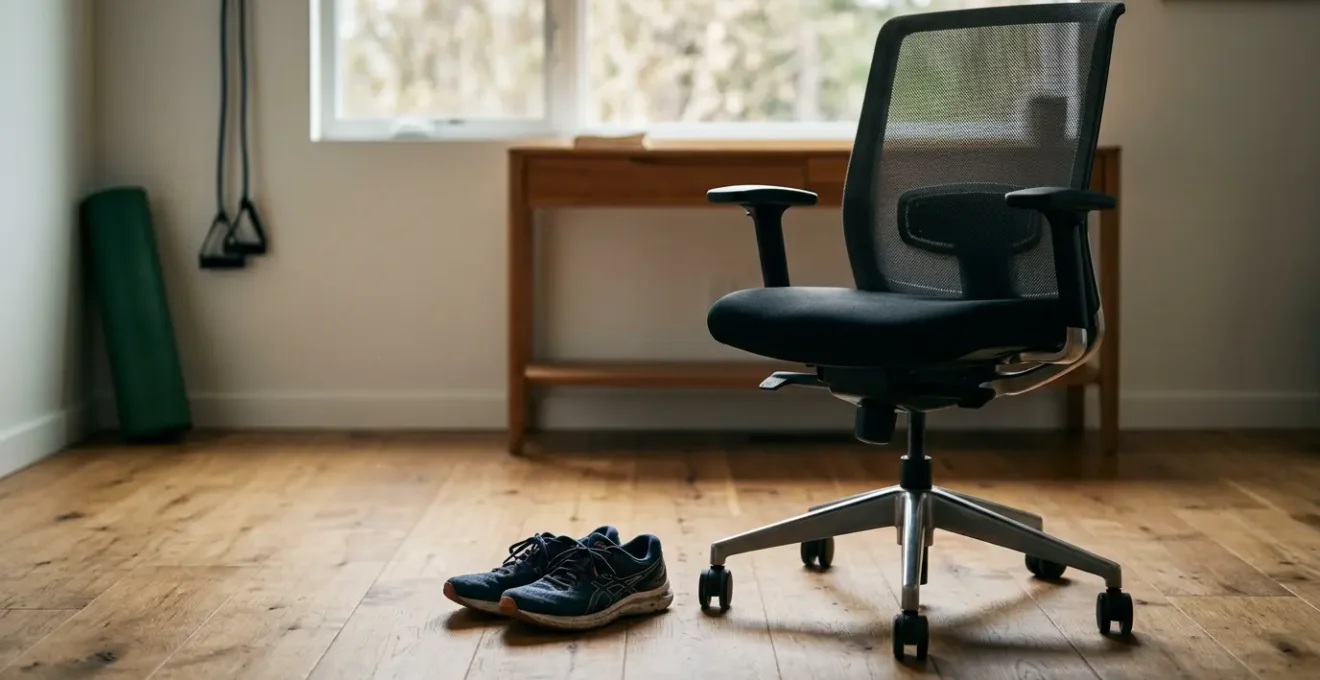
Reversing glute amnesia isn’t about brute force exercise; it’s about systematically retraining your brain-to-muscle connection to correct the postural damage from prolonged sitting.
- Static standing desks offer minimal metabolic benefits; dynamic movement is the key to reactivating your metabolism and muscles.
- Identifying the root cause—whether tight hip flexors or weak abdominals—is the first step before any corrective exercise can be effective.
Recommendation: Integrate short, focused “movement snacks” into your workday to re-establish proper neuromuscular firing patterns and combat the effects of a sedentary lifestyle.
If you’re an office worker, you know the feeling: you stand up after hours at your desk, and a familiar stiffness greets your lower back while your glutes feel completely disconnected. You’ve likely heard the common advice—get a standing desk, do more squats, stretch your hips. Many try these solutions with frustratingly little success, ending up with the same dull ache and a posture that seems to slump forward no matter what they do. This phenomenon, often called “gluteal amnesia,” is more than just weak muscles; it’s a sign that your nervous system has forgotten how to use them correctly.
The problem is a postural cascade. When your glutes don’t fire, your body recruits other muscles, like your lower back and hamstrings, to do their job. This creates a chain reaction of imbalance that can lead to anterior pelvic tilt (swayback), tension headaches, and even circulatory issues. The key to breaking this cycle isn’t just strengthening your glutes; it’s about neuromuscular re-education. It’s about waking up the dormant pathways between your brain and your backside and teaching your body to move as an integrated system again.
But what if the true solution isn’t found in a punishing gym routine, but in small, intelligent adjustments to your daily life? This guide will move beyond the platitudes and provide a corrective exercise specialist’s approach. We will dissect why common solutions fall short, help you diagnose the specific cause of your postural issues, and give you a clear, actionable strategy to re-engage your glutes, alleviate pain, and undo the systemic damage of sitting. We’ll explore the science behind inactivity, from metabolic slowdown to lymphatic congestion, and equip you with the tools to build a resilient, functional body, even with a desk job.
This article provides a comprehensive roadmap, breaking down the problem and its solutions into clear, manageable sections. The following summary outlines the key areas we will cover to help you restore proper function and movement hygiene.
Summary: Reversing the Effects of a Sedentary Work Life
- Why standing desks alone don’t solve the metabolic issues of inactivity?
- How to implement “movement snacks” every 45 minutes without losing focus?
- Hip flexor tightness vs Weak abs: determining the cause of your swayback
- The circulation error: why crossing legs leads to varicose veins
- Commuting strategy: active travel hacks for car drivers
- Why “text neck” causes tension headaches in 80% of office workers?
- Why sedentary jobs block lymph flow in the pelvic region?
- When Is Spinal Manipulation Safe for Chronic Lower Back Pain?
Why standing desks alone don’t solve the metabolic issues of inactivity?
The transition to a standing desk is often hailed as the definitive solution to a sedentary job. However, from a corrective exercise perspective, simply swapping sitting for static standing is a marginal improvement at best. The underlying issue is not the position itself, but the profound lack of movement. Your body is designed for dynamic activity, and merely changing your vertical orientation doesn’t provide the muscular engagement or metabolic stimulus it craves. In fact, research shows the caloric difference is minimal; standing burns only about 15 extra calories per hour compared to sitting.
The real metabolic magic happens with movement, even subtle movement. A fascinating 2018 study published in Work found that modest movement while seated, such as fidgeting or using dynamic seating, elevated metabolic rate by 17.6%. This was significantly more than the increase from passively standing. This highlights a crucial principle: neuromuscular activation, not static posture, is what reverses the metabolic slowdown caused by inactivity. When you stand rigidly, your muscles are held in a low-level, isometric contraction, which does little to promote circulation, activate the glutes, or stimulate the lymphatic system. It can also lead to its own set of problems, like foot pain and lower back strain, if posture isn’t optimal.
To truly combat the effects of a desk job, we must reframe the goal from “standing more” to “moving more frequently.” The illustration below helps visualize the difference between passive, static posture and active, dynamic engagement at a workstation.
As you can see, the key is to introduce variability and micro-movements. This concept of “active standing” involves shifting your weight, using a footrest to alternate leg positions, or performing gentle calf raises. It’s about transforming your workstation from a static trap into a dynamic environment. This approach provides the necessary proprioceptive feedback to keep your nervous system engaged and prevents the muscles, especially the glutes, from falling back into a state of amnesia. Without this dynamic component, a standing desk is just a different way to be inactive.
How to implement “movement snacks” every 45 minutes without losing focus?
The idea of breaking up your workday with exercise can seem counterproductive, evoking images of lost focus and derailed trains of thought. The solution is not a full-blown workout, but the strategic implementation of “movement snacks.” These are short, 1-to-5-minute bursts of targeted activity designed to reset your posture and reactivate dormant muscles without pulling you out of your cognitive flow. The science backs this up: according to a 2022 systematic review published in PLOS ONE, which analyzed 22 studies, these micro-breaks significantly boost vigor and reduce fatigue.
The key to maintaining focus is the *quality* and *intention* of the break. A mindless scroll through social media is a high-distraction break that can make it harder to return to a task. In contrast, a low-distraction movement snack, where you remain mentally connected to your work environment, can enhance performance. This isn’t just theory; it’s a proven productivity booster.
The Fruit Harvester Study: Focused Breaks Boost Productivity
Research from Texas McCombs provides a powerful real-world example. The study examined fruit harvesters and found that low-distraction breaks, where the workers could physically rest but remained mentally oriented to their task, improved productivity by 7.12% for every five minutes of pause. High-distraction breaks, conversely, had a negative impact. This shows that a short, purposeful physical break doesn’t have to break your concentration; it can actually sharpen it.
To implement this effectively, set a timer for every 45 minutes. When it goes off, perform a simple, pre-planned routine. This could be 10 bodyweight squats, 10 glute bridges (you can do these standing and pushing your hips back), or a 60-second plank. The goal is neuromuscular re-education. You are reminding your brain how to fire your glutes and core. By making the routine consistent and simple, you reduce the cognitive load of deciding what to do, allowing you to perform the movements almost automatically and return to your work refreshed and with better posture.
Hip flexor tightness vs Weak abs: determining the cause of your swayback
One of the most common postural dysfunctions seen in office workers is an anterior pelvic tilt (APT), or “swayback,” where the pelvis tips forward, creating an exaggerated arch in the lower back. This posture is a primary driver of lower back pain and a key symptom of glute amnesia. But correcting it requires identifying the root cause: is it primarily due to tight hip flexors pulling the pelvis down, or weak abdominal muscles that are unable to hold it up? Often, it’s a combination of both, creating an imbalance known as lower crossed syndrome.
Before jumping into a generic routine of stretches and crunches, a simple self-assessment is necessary to determine which issue is more dominant for you. While a significant pelvic tilt is a problem, it’s important to have perspective. In fact, research measuring 120 healthy subjects found that 85% of males and 75% of females naturally present with some degree of anterior pelvic tilt without any symptoms. The issue arises when this tilt becomes excessive due to muscular imbalances, leading to pain and dysfunction. Your goal is to restore balance, not achieve a perfectly “neutral” pelvis, which may not be natural for your body.
One of the most reliable ways to test for hip flexor tightness is the Thomas Test. By isolating the hip flexors, this assessment can clearly show if they are restricting your pelvic position and contributing to your swayback.
To get a clearer picture of your personal postural pattern, you can perform a few simple tests at home. The following checklist will guide you through a self-assessment to help you pinpoint whether tight hips, a weak core, or both are the primary contributors to your swayback posture. This diagnosis is the critical first step in creating an effective corrective strategy.
Action Plan: Pinpoint the Source of Your Swayback
- The Thomas Test: Lie on your back on a sturdy table or bed, with your legs hanging off from the knee. Pull one knee firmly to your chest. Observe the other (resting) leg. If the back of its thigh lifts off the surface, your hip flexors on that side are tight.
- Visual Mirror Assessment: Stand sideways to a full-length mirror in your natural, relaxed posture. Look for a pronounced arch in your lower back and a forward-tilting belt line. If your buttocks appear prominent and your abdomen protrudes, this is a strong indicator of APT.
- Wall Test for Abdominal Control: Stand with your back flat against a wall, feet about six inches away from it. You should have a small, natural curve in your lower back. Now, try to actively flatten that curve by pressing your lower back into the wall, using only your abdominal muscles. If you struggle significantly or have to bend your knees to do it, it indicates weak deep core muscles.
- Glute Squeeze Test: While standing, try to squeeze your glutes. Observe in the mirror. A proper glute contraction should cause your pelvis to rotate slightly backward (posteriorly), reducing the arch in your lower back. If you barely see a change, it’s a sign of glute amnesia.
- Lying Leg Raise Test: Lie on your back with your legs straight. Place your hands under the small of your back. Slowly raise both legs about six inches off the floor. If your back arches and lifts off your hands, your abdominals are not strong enough to stabilize your pelvis against the pull of your hip flexors.
The circulation error: why crossing legs leads to varicose veins
Beyond the musculoskeletal issues of glute amnesia and back pain lies a less visible but equally serious consequence of prolonged sitting: impaired circulation. The habit of crossing one’s legs, common among desk workers seeking a more stable or comfortable position, exacerbates this problem significantly. While it may feel benign, this posture mechanically compresses veins in the crossed-over leg, impeding the return of blood to the heart. This increases venous pressure in the lower extremities, a primary factor in the development of varicose veins.
The venous system in your legs is an engineering marvel, relying on a series of one-way valves and the pumping action of your calf and leg muscles to push blood upward against gravity. When you sit, this “muscle pump” is inactive. Blood begins to pool, and the pressure inside the veins rises. Crossing your legs adds a physical bottleneck to this already sluggish system. Over time, the constant elevated pressure can stretch the vein walls and damage the delicate valves, leading to venous insufficiency, where blood flows backward and pools, causing the bulging, twisted appearance of varicose veins. This isn’t a rare condition; studies have shown that more than 30 million Americans suffer from varicose veins, with a sedentary lifestyle being a major aggravating factor.
Mechanism of Sitting-Induced Venous Insufficiency
The Vein Institute of Pittsburgh provides a clear explanation of this process. When the muscle pumps in the legs are inactive during prolonged sitting, blood flow slows dramatically. The pooling blood stretches and weakens the veins, causing the one-way valves to fail. This not only leads to the cosmetic issue of varicose veins but also contributes to symptoms like aching, swelling, and heaviness in the legs. In severe cases, this chronic circulatory stagnation can increase the risk of more serious conditions like deep vein thrombosis (DVT).
From a corrective standpoint, the solution involves two components: breaking the habit of leg-crossing and reactivating the calf muscle pump. The first requires conscious effort and postural awareness. Try placing both feet flat on the floor or on a footrest. The second is achieved through the “movement snacks” discussed earlier. Simple exercises like ankle circles, pointing and flexing your feet, and performing seated or standing calf raises every hour are highly effective at restoring blood flow. This active approach is a core part of comprehensive movement hygiene, addressing not just muscles and bones but the entire circulatory system affected by a sedentary job.
Commuting strategy: active travel hacks for car drivers
The battle against a sedentary lifestyle doesn’t start and end at the office door. For many, the daily commute is another significant block of inactive time, reinforcing the very postural patterns we’re trying to break. Reclaiming this time with “active travel hacks” can dramatically increase your daily movement and accelerate your progress in reversing glute amnesia. While you can’t exactly perform squats while driving, you can transform your commute from a passive experience into an active part of your recovery.
The strategy is to sprinkle moments of activity around your drive. This starts before you even get in the car. Park farther away from your office entrance. That extra 5-10 minute walk each way is a perfect opportunity for a brisk, mindful stroll. Focus on your gait: land on your mid-foot, push off through your big toe, and consciously squeeze the glute of your back leg with every step. This turns a simple walk into a targeted glute activation exercise. Similarly, always opt for the stairs over the elevator. Taking stairs two at a time is an excellent way to engage your glutes and quads.
You can even use the time spent in the car. While stopped at a red light, perform isometric glute contractions. Squeeze your glutes as hard as you can for a count of five and release. Repeat this 5-10 times. This small action helps maintain the neuromuscular connection you’re working to build. Also, pay close attention to your driving posture. Adjust your seat so your knees are slightly lower than your hips, which reduces hip flexor tightness. Use a small lumbar roll to support the natural curve of your lower back and prevent slumping. By treating your commute as an extension of your movement practice, you layer in consistent, positive inputs throughout your day, creating a powerful cumulative effect.
Why “text neck” causes tension headaches in 80% of office workers?
That persistent, dull ache at the base of your skull and across your temples may feel disconnected from your “dead butt” problem, but it’s often a direct consequence of it. This is the endpoint of the postural cascade that begins with inactive glutes. When your glutes are weak, your pelvis tilts forward (anterior pelvic tilt). To keep your body upright and your eyes on the horizon, your spine must compensate. This often results in an increased rounding of the upper back (thoracic kyphosis), which in turn forces your head to jut forward. This forward head posture is the hallmark of “text neck.”
For every inch your head moves forward from its optimal alignment over your shoulders, its effective weight on your cervical spine doubles. A 12-pound head held one inch forward puts 24 pounds of strain on your neck muscles; at three inches, it’s a staggering 42 pounds. The small suboccipital muscles at the base of your skull, which are designed for fine motor control of the head, become chronically overworked just trying to hold your head up. This constant tension compresses nerves and restricts blood flow, directly leading to tension headaches. It’s no wonder this is a widespread issue, with some studies suggesting that posture-related strain is a factor in as many as 80% of tension headaches among office workers.
Simply trying to “pull your head back” is a temporary fix that fails to address the foundation of the problem. The solution is not to focus on the neck in isolation, but to correct the entire postural chain, starting from the ground up. By reactivating your glutes and teaching your pelvis to return to a more neutral position, you provide a stable base for your spine. This allows the curve in your upper back to lessen, which in turn enables your head to naturally retract into its proper alignment. This systemic approach is the only way to permanently offload the neck muscles and resolve the root cause of these debilitating headaches.
Why sedentary jobs block lymph flow in the pelvic region?
While the focus on glute amnesia is often on muscles and posture, a critical and frequently overlooked consequence of prolonged sitting is the stagnation of the lymphatic system. Unlike your circulatory system, which has the heart as a central pump, the lymphatic system is a passive network. It relies almost entirely on the contraction of your muscles to move lymph fluid—which carries waste products away from tissues—throughout your body. The pelvic region, with its dense network of lymph nodes, is particularly vulnerable to this inactivity.
When you sit for hours, the large muscles of your lower body—especially the glutes and leg muscles—are dormant. This lack of a “muscle pump” causes lymph fluid to pool in the lower body and pelvic basin. Furthermore, the very act of sitting, with the hip flexors in a shortened position, creates a physical compression at the inguinal crease (where the thigh meets the pelvis), a major superhighway for lymphatic vessels. This double-whammy of inactivity and compression leads to significant lymphatic congestion.
The symptoms of this blockage are often subtle and easily misattributed. They can include a feeling of heaviness or bloating in the lower abdomen, puffy ankles, reduced immune function, and a general sense of lethargy. This is your body’s waste disposal system backing up. Correcting this requires movement. Activities that involve the large muscles of the legs and hips, like squats, lunges, and even brisk walking, are incredibly effective at stimulating lymphatic drainage. Even simple “movement snacks” like glute bridges or leg swings can help get things moving again. Reversing glute amnesia is therefore not just about building a stronger posture; it’s also about reactivating the internal cleansing system that is essential for your overall health and energy levels.
Key Takeaways
- True progress comes from neuromuscular re-education—teaching your brain to fire your glutes correctly—not just brute-force exercise.
- Your body is a connected system; glute inactivity triggers a postural cascade leading to back pain, neck strain, and even headaches.
- Frequent, short “movement snacks” are more effective at resetting posture and metabolism than passively standing for long periods.
When Is Spinal Manipulation Safe for Chronic Lower Back Pain?
For those suffering from the nagging, chronic lower back pain that so often accompanies glute amnesia, seeking immediate relief is understandable. Spinal manipulation, performed by a qualified chiropractor or physical therapist, can be a highly effective and safe tool for this purpose. Manipulation can help restore joint mobility, reduce muscle tension, and provide significant, often immediate, pain relief by addressing joint restrictions that have developed as a result of poor posture and compensatory movement patterns. It is particularly useful in the acute phase of a flare-up to break the pain-spasm cycle and create a window of opportunity for you to move more freely.
However, it is crucial to view spinal manipulation as one component of a larger strategy, not as a standalone cure. It is an excellent way to treat the *symptom*—the stiff joint and the resulting pain. But it does not address the *root cause*, which is the faulty movement pattern and muscular imbalance stemming from gluteal amnesia. Think of it like this: spinal manipulation unlocks the door, but corrective exercise is what teaches you how to walk through it correctly and prevents it from locking up again.
The safest and most effective approach is an integrated one. Use spinal manipulation when your pain is limiting your ability to function or begin a rehabilitation program. Once the acute pain has subsided, you must immediately follow up with the corrective exercises designed to awaken your glutes, strengthen your core, and restore proper pelvic alignment. Without this follow-through, you will likely find yourself back in the clinician’s office a few weeks or months later with the same problem. Lasting relief only comes from fixing the fundamental reason your back became painful in the first place: your glutes weren’t doing their job.
Begin today by performing the self-assessment tests to understand your unique postural pattern. This is the first, most crucial step toward building a targeted and effective plan to reclaim your body from a sedentary life.