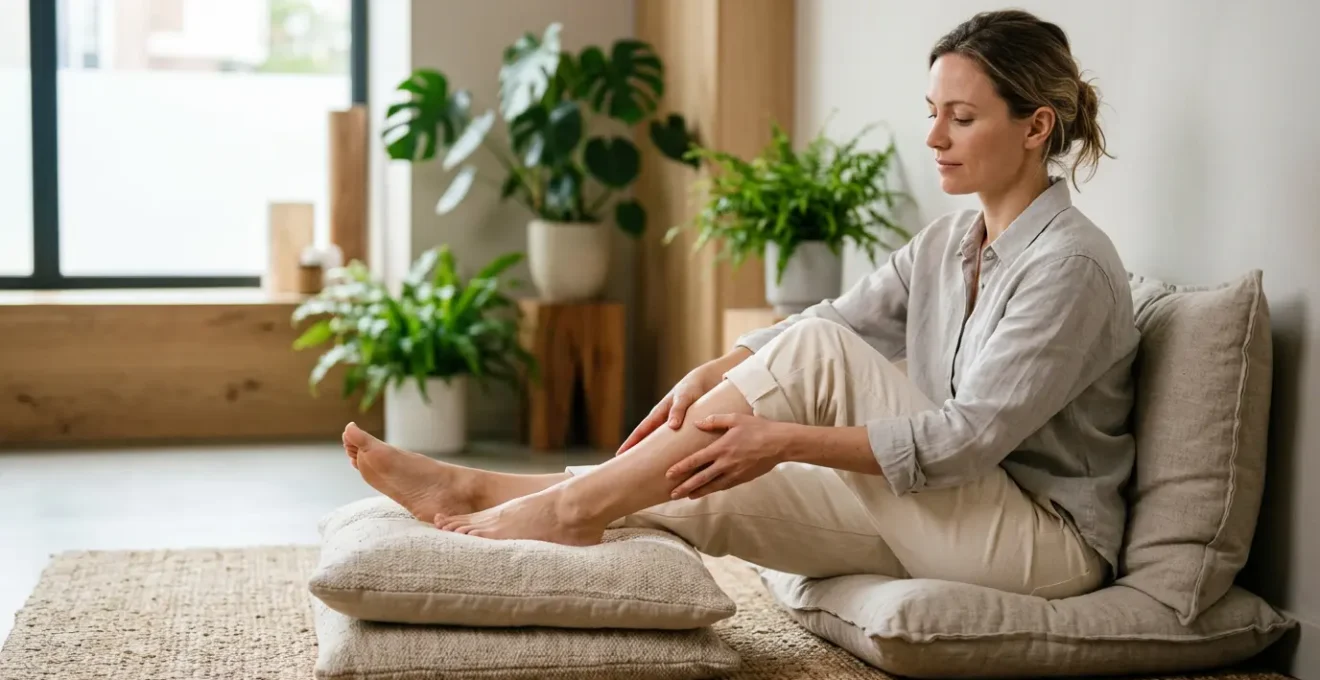
That heavy, swollen feeling in your legs isn’t just about excess water; it’s a sign of a breakdown in your body’s internal plumbing. Chronic fluid retention signals that your lymphatic system—the body’s waste disposal network—is congested. Instead of temporary fixes, the real solution lies in systematically clearing central blockages, reactivating your body’s natural “pump” through targeted movement, and supporting the entire circulatory system to flush out stagnant fluid for good.
The workday ends, you stand up from your desk, and you feel it: a familiar heaviness in your calves, ankles puffed up, and a general sense of sluggishness. For many sedentary workers and frequent flyers, this chronic fluid retention has become an unwelcome daily reality. The common advice often includes drinking more water, elevating your legs, or cutting back on salt. While these tips can offer fleeting relief, they fail to address the root of the problem, acting like a bandage on a complex mechanical issue.
Think of your body’s circulatory and lymphatic networks as a sophisticated plumbing system. Blood vessels are the supply lines, while the lymphatic system is the critical drainage and waste removal network. When fluid pools in your legs, it’s not just a simple overflow; it’s a sign of a blockage or a failure in the pump mechanism. The real issue often isn’t in your ankles but further upstream, in the core of your body, where major lymphatic “pipes” are being compressed day after day.
But what if you could become your own plumber? What if the key wasn’t a diuretic pill that forces fluid out, but a series of techniques to restore the system’s natural, powerful flow? This guide moves beyond surface-level advice to give you a specialist’s perspective on lymphatic health. We will dismantle the problem piece by piece, from identifying the primary “central blockage” caused by sitting to implementing a system-wide “flush” that reactivates your body’s innate ability to cleanse itself. This is about fixing the machinery, not just mopping up the spill.
This article provides a complete, step-by-step framework to reboot your body’s fluid dynamics. You’ll learn how to identify and correct the daily habits that sabotage your circulation and master simple, powerful techniques to restore healthy flow. The following sections are designed to guide you through this process, from diagnosis to a full system reset.
Table of Contents: A System-Wide Guide to Reducing Leg Swelling
- Why Sedentary Jobs Block Lymph Flow in the Pelvic Region?
- How to Perform a 5-Minute Lymphatic Massage on Yourself Every Morning?
- Rebounding or Walking: Which Pumps Lymph Fluid More Efficiently?
- The Tight Clothing Mistake That Creates “Tourniquet Effects” on Circulation
- Contrast Showers: The Correct Hot-Cold Sequence to Flush Toxins
- The Circulation Error: Why Crossing Legs Leads to Varicose Veins
- Why Dandelion Root Is Superior to Milk Thistle for Kidney Flushing?
- How to Reverse “Glute Amnesia” From Sitting All Day?
Why Sedentary Jobs Block Lymph Flow in the Pelvic Region?
The primary culprit behind your swollen ankles isn’t in your ankles at all—it’s in your hips. When you sit for prolonged periods, you create a major “central blockage” in your body’s plumbing system. The crease at your hip joint, where your torso meets your legs, houses a dense cluster of deep inguinal lymph nodes. These nodes are a critical junction, responsible for filtering and moving all the lymphatic fluid from your lower body back toward your chest for processing. Sitting essentially kinks this major drainage pipe for hours on end.
Unlike your cardiovascular system, which has the heart as a powerful central pump, the lymphatic system is passive. It relies entirely on the contraction of muscles and subtle body movements to propel fluid through its delicate, one-way-valved vessels. When you are sedentary, this internal pump shuts down. The constant pressure from sitting flattens the gluteal muscles and compresses the pelvic region, leading to what is known as lymphatic stagnation. Fluid that should be efficiently moving upward gets trapped downstream, pooling in your lower legs, ankles, and feet.
This isn’t just a matter of temporary discomfort. Over time, this chronic congestion can overwhelm the system. In fact, compelling research shows a sedentary lifestyle compromises lymphatic function throughout the body, not just in the limbs. By understanding that the problem starts at the core, you can shift your focus from simply elevating your feet to actively “un-kinking” the main pipeline in your pelvis through targeted movement and postural changes throughout the day.
How to Perform a 5-Minute Lymphatic Massage on Yourself Every Morning?
To counteract the stagnation caused by sitting, you can manually kickstart your lymphatic system with a simple 5-minute self-massage each morning. This isn’t a deep-tissue muscle massage; the goal is to gently stretch the skin to stimulate the superficial lymphatic vessels that lie just beneath it. These vessels are responsible for collecting stagnant fluid and moving it toward the larger drainage channels. The key is to use a feather-light touch, as too much pressure will bypass these delicate structures and press into the muscle instead.
Begin by activating the “drains” before you start moving fluid toward them. Gently pump the areas with major lymph node clusters: the soft hollows above your collarbones (terminus), your armpits (axillary nodes), and the crease of your hips (inguinal nodes). Press gently and release, about 10-15 times in each spot. This signals to the system that it’s time to start processing fluid.
Now, focus on the legs. Using the flats of your hands, perform slow, gentle, rhythmic strokes upward from your ankles toward your knees. Then, continue from your knees up toward your hips, always directing the flow toward the inguinal nodes you just activated. The motion should be just enough to gently pull the skin. Visualize you are moving a pool of stagnant water up a very gentle slope. This technique, when done consistently, helps clear the “pipes” before you even get out of bed, setting the stage for better circulation throughout the day.
As this image demonstrates, the technique involves a broad, gentle contact with the skin. Notice the hand is not digging or kneading but making a light, directional sweep. This skin-stretching motion is the secret to effectively engaging the superficial lymphatic vessels and encouraging the movement of trapped interstitial fluid.
Rebounding or Walking: Which Pumps Lymph Fluid More Efficiently?
While manual massage helps clear local pathways, activating the “internal pump” requires whole-body movement. The two most accessible methods for this are walking and rebounding (jumping on a mini-trampoline). Though both are beneficial, they work on different principles and offer distinct advantages for lymphatic drainage. Walking is excellent for maintenance, but for a powerful, system-wide flush, rebounding is biomechanically superior.
Walking primarily utilizes the “calf muscle pump.” Each time you take a step, your calf muscles contract and squeeze the deep veins and lymphatic vessels in your lower legs, pushing fluid upward against gravity. This is a crucial mechanism for preventing blood and lymph from pooling in the feet and is highly effective for counteracting long periods of sitting or standing. It’s the perfect low-impact activity to integrate throughout your day.
Rebounding, however, engages a more powerful force: acceleration and deceleration. As you bounce, every cell in your body experiences a brief moment of weightlessness at the top of the jump and increased G-force at the bottom. This rhythmic vertical movement forces all one-way lymphatic valves to open and close simultaneously, creating a powerful, total-body pumping action that flushes the entire system far more efficiently than the localized pump of walking. Just a few minutes of gentle bouncing can dramatically increase lymph flow.
This table breaks down the key differences, based on an analysis of exercise’s effect on the lymphatic system.
| Factor | Rebounding (Mini-Trampoline) | Walking |
|---|---|---|
| Lymph Flow Increase | 15-30x baseline flow | Moderate increase |
| Mechanism | G-force flush – acceleration/deceleration forces all one-way lymphatic valves to open and close simultaneously | Calf muscle pump – localized activation in lower legs |
| Body Coverage | Total-body system flush | Primarily lower leg circulation |
| Time Efficiency | 2-10 minutes for full lymphatic flush | 30+ minutes for comparable benefits |
| Best Use | Morning ‘system-wide wake-up call’ | Throughout day to prevent sitting-related stagnation |
| Joint Impact | Low impact, gentle on joints | Low impact, weight-bearing |
The Tight Clothing Mistake That Creates “Tourniquet Effects” on Circulation
You can do all the massage and exercise you want, but if you put on restrictive clothing afterward, you are essentially clamping the very pipes you just worked to clear. Tight clothing—especially items with unforgiving elastic bands like skinny jeans, tight socks, or shapewear—can create a subtle but significant “tourniquet effect” on your lymphatic system. These garments create constant, localized pressure that obstructs the gentle, low-pressure flow of lymph fluid.
The most vulnerable areas are the major lymphatic “junction boxes” where nodes are clustered close to the surface: the groin (inguinal nodes), behind the knees (popliteal nodes), the armpits (axillary nodes), and the abdomen. A tight waistband on your pants directly compresses the abdominal and inguinal pathways, impeding drainage from the entire lower body. Similarly, the elastic band at the top of a tight sock can hinder the upward flow from your foot and ankle. According to a clinical review from the National Institutes of Health, such constrictions can obstruct collateral circulation at these key node clusters.
The solution is to opt for clothing made from natural, breathable fibers with a more forgiving fit. Look for pants with wide, soft waistbands, seamless socks that don’t leave deep indentations, and underwear that doesn’t dig into the groin. It’s not about wearing baggy clothes, but about being conscious of “pressure points.” Choosing garments that allow your body to move and breathe freely is a passive yet powerful way to support healthy fluid dynamics all day long.
This visual contrast between free-flowing and constricted fabric serves as a powerful metaphor. The bunched, tight material on the right represents the chronic compression that restrictive clothing places on your lymphatic pathways, while the loose drape on the left symbolizes the freedom required for optimal fluid circulation.
Contrast Showers: The Correct Hot-Cold Sequence to Flush Toxins
One of the most powerful hydrotherapy techniques for a full “system flush” is the contrast shower. This simple practice uses alternating temperatures to create a passive pumping action within your circulatory and lymphatic systems. It acts as a workout for your vessels, dramatically enhancing circulation and helping to move stagnant, waste-filled fluid out of your tissues and toward your body’s processing centers.
The mechanism is straightforward: hot water causes vasodilation, where blood and lymphatic vessels widen and relax. This invites fluid and blood flow into the area. Conversely, cold water causes vasoconstriction, where the vessels clamp down and squeeze. By rapidly alternating between hot and cold, you create a powerful pump-and-release cycle that pushes stagnant fluid along its path. Think of it like squeezing a sponge to wring out old water.
However, the sequence is critical for maximizing lymphatic benefits. You must always end on cold. The final blast of cold water provides a last, powerful squeeze that pushes deoxygenated blood and metabolic waste toward the liver and kidneys for filtration, while shunting lymphatic fluid into the proper drainage channels. Ending with hot would leave the vessels dilated and can actually encourage fluid to pool back in the extremities, defeating the purpose.
Your Action Plan: The Lymphatic Flush Shower Protocol
- Start with Heat (2-3 minutes): Begin your shower with comfortably hot water. This causes vasodilation, widening the vessels and drawing stagnant fluid into the circulatory pathways.
- Switch to Cold (30-60 seconds): Abruptly switch the water to as cold as you can tolerate. This causes vasoconstriction, a powerful squeeze that propels the fluid forward. Focus the water on your legs, moving from feet to hips.
- Repeat the Cycle (3-5 times): Alternate between the hot and cold phases. With each cycle, you are strengthening the pumping action and moving more fluid through the system.
- Always End on Cold: This is the most crucial step. The final cold exposure acts as the last “push,” ensuring waste-filled fluid is directed toward your lymphatic channels and away from your limbs.
- Beginner’s Modification: If a full-body cold blast is too intense, start by applying the hot/cold sequence only to your legs, always directing the showerhead from your feet upwards to assist the natural direction of lymph flow.
The Circulation Error: Why Crossing Legs Leads to Varicose Veins
One of the most common and seemingly innocent postural habits—crossing your legs—is a direct saboteur of lower-body circulation. While it might feel comfortable or natural, this position creates sustained pressure on the veins and lymphatic vessels in both legs, contributing to the development of venous insufficiency, swelling, and eventually, varicose veins.
When you cross one leg over the other, you are physically compressing the major vascular structures running along your legs, particularly the popliteal vein behind the knee. This creates a downstream bottleneck, forcing your heart to pump harder to push blood through the constricted area. More importantly, it dramatically increases the venous back-pressure in the lower leg. The delicate, one-way valves inside your veins are designed to prevent blood from flowing backward due to gravity. When you cross your legs, you force these tiny valves to struggle against a wall of pressure.
Over time, this chronic strain can cause the valves to weaken and fail. When a valve fails, blood is no longer efficiently moved upward and begins to pool, stretching and distending the vein wall. This is the exact mechanism that leads to the formation of spider veins and larger varicose veins. It’s a classic plumbing failure: the check valves in the pipes have broken, causing reverse flow and localized bulging. Making a conscious effort to sit with both feet flat on the floor is a simple yet profound change that removes this unnecessary obstruction and supports the long-term health of your veins.
Why Dandelion Root Is Superior to Milk Thistle for Kidney Flushing?
Once you’ve mobilized stagnant fluid using massage, exercise, and hydrotherapy, you need to ensure your body’s “filtration plant”—the kidneys—can efficiently process and excrete it. While many herbs are touted for detoxification, dandelion root (Taraxacum officinale) holds a distinct advantage over others like milk thistle for the specific purpose of flushing excess fluid.
Milk thistle is an excellent herb, but its primary action is hepatoprotective, meaning it supports and protects liver function. The liver is a key organ for detoxification, but it is not the primary organ for fluid excretion. That job belongs to the kidneys. Dandelion, on the other hand, is a well-documented aquaretic. This means it specifically helps the kidneys excrete excess water without causing a significant loss of essential electrolytes. This direct action on the body’s fluid volume makes it a targeted tool for reducing edema.
Furthermore, what makes dandelion truly superior in this context is its natural richness in potassium. Many pharmaceutical diuretics (water pills) work by forcing the kidneys to excrete sodium, and water follows. A major side effect is that they also cause the body to lose potassium, a critical mineral for maintaining proper fluid balance and heart function. As documented in reviews of holistic medicine, dandelion acts as a “potassium-sparing” diuretic. It helps flush excess water while simultaneously replenishing the body’s potassium stores, making it a much safer and more balanced choice for long-term fluid management. It supports the filtration system without stripping it of a key operational component.
Key Takeaways
- Fluid retention in the legs often starts with a “central blockage” in the pelvic area caused by prolonged sitting.
- The lymphatic system requires movement to function; techniques like self-massage, rebounding, and walking act as an “internal pump” to move stagnant fluid.
- Daily habits matter: tight clothing and crossing legs create physical obstructions that sabotage circulation.
- Contrast showers create a powerful “pump-and-flush” action, while herbs like dandelion root support the kidneys in eliminating the excess fluid.
How to Reverse “Glute Amnesia” From Sitting All Day?
The final piece of the puzzle lies in reactivating the very muscles that sitting has put to sleep: your glutes. “Gluteal amnesia” is a modern condition where the glute muscles forget how to fire properly due to chronic underuse from sitting. This is more than a cosmetic issue; it’s a major circulatory problem. The glutes are the largest and most powerful muscle group in the body, and their contraction is a primary engine for pumping blood and lymph out of the lower body.
When your glutes are inactive, smaller, less-equipped muscles like the hamstrings and lower back are forced to compensate, leading to imbalances and pain. More importantly for fluid retention, a weak “glute pump” means the entire plumbing system of the lower body is running on low power. Fluid pools more easily because the main engine designed to propel it upward is offline. Reversing glute amnesia is therefore not just about strength training—it’s about re-establishing a fundamental mind-muscle connection to turn this powerhouse back on.
The process starts with simple activation exercises, not heavy lifting. The goal is to “wake up” the dormant neural pathways before asking the muscles to perform heavy work. Integrating these movements into your daily routine, especially as breaks from sitting, can reboot the gluteal pump and provide a lasting solution to lower-body stagnation. According to studies published in the Journal of Lymphoedema, exercise with compression can further enhance this effect. Here is a simple protocol to begin:
- Glute Bridges: Lie on your back with knees bent. Focus intently on squeezing your glutes to lift your hips off the floor. The goal is to feel the glutes initiate the movement, not the lower back or hamstrings.
- Bird-Dogs: Start on your hands and knees. Slowly extend your right arm forward and your left leg backward, keeping your core tight and your hips level. The focus is on controlled extension powered by the glute of the extended leg.
- Hourly Squeeze Breaks: Set a timer to stand up once an hour. For 30 seconds, consciously and forcefully squeeze your glutes. Follow with 30 seconds of alternating leg-back extensions. This simple reset reminds the muscles of their job.
By systematically addressing each component of your body’s plumbing—from clearing blockages and restarting the pump to supporting the filtration system—you can move beyond temporary fixes. Take control of your body’s internal systems, implement these strategies consistently, and start flushing stagnant fluid today for lighter, healthier legs.