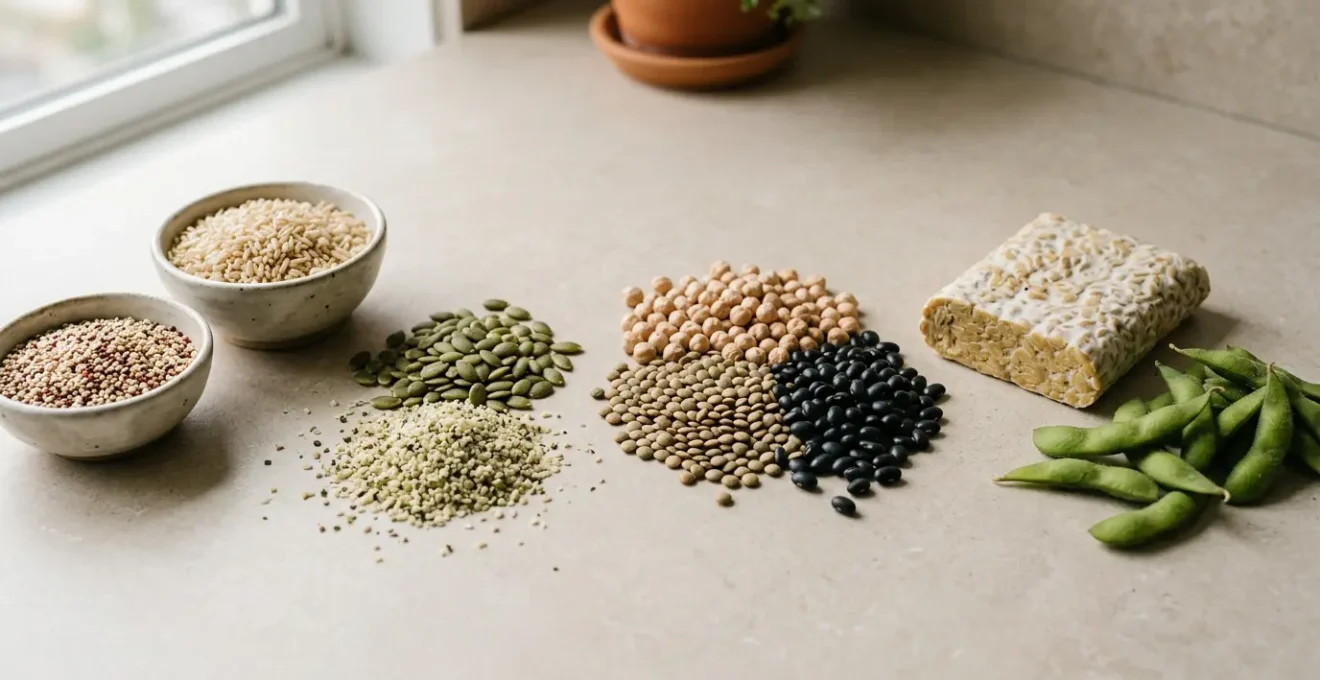
Building serious muscle on a plant-based diet isn’t about vague ‘protein combining’—it’s about mastering the science of amino acid triggers.
- The “leucine threshold” is the non-negotiable switch for muscle growth, and plant-based athletes must strategically target it at each meal.
- Digestibility and meal timing are more critical than total daily protein, determining how much is actually used for recovery.
Recommendation: Focus on hitting 2.5-3g of leucine per meal and distributing your intake every 3-4 hours, rather than just tracking total grams per day.
For many vegetarians and flexitarians, the concern over getting “enough” protein is a constant background hum. You’re committed to a plant-forward lifestyle but worry if it’s compromising your strength, recovery, and ability to maintain or build lean muscle. The conventional wisdom often involves vague advice about “eating a variety” or combining rice and beans, but for those with performance goals, this isn’t specific enough. It leaves you wondering if you’re truly optimizing your nutrition or just getting by. Are you missing key nutrients? Is your hard work in the gym being undermined by an incomplete amino acid profile?
The conversation around plant protein is often stuck on the outdated concept of “complete” versus “incomplete” sources that must be paired at every meal. This misses the bigger picture. The real key to unlocking muscle growth and robust immunity from plant sources doesn’t lie in rigid food pairings, but in understanding a more dynamic system. It’s a strategy that involves hitting specific amino acid triggers, enhancing bioavailability, and synchronizing your intake with your body’s needs. This isn’t just about avoiding deficiency; it’s about creating a powerful anabolic environment for peak performance.
This guide moves beyond the myths. We’ll deconstruct the science of plant-based muscle synthesis into an actionable framework. We will explore the critical role of the leucine threshold, provide methods to optimize digestion, clarify the confusion around soy, and detail how to time your meals for maximum recovery. You’ll gain a nutritionist’s perspective on building a powerful, resilient body exclusively with plant-based foods.
To navigate this comprehensive guide, we’ve broken down these advanced strategies into clear, focused sections. The following summary outlines the key pillars of a high-performance, plant-based protein strategy, allowing you to master each component of the system.
Summary: A Strategic Guide to Plant Protein for Muscle and Health
- Why the “leucine threshold” matters more for vegans building muscle?
- How to improve the digestibility of legumes to reduce gas?
- Soy protein isolate vs Whole soy: which is safer for hormonal health?
- The anti-nutrient myth: do phytates actually block mineral absorption significantly?
- Meal timing: synchronizing protein intake for optimal vegan recovery
- Why muscle mass declines faster after 40 without resistance training?
- How to calculate protein needs for wound healing and tissue repair?
- How to Adapt Your Fitness Routine After 50 to Prevent Injury?
Why the “leucine threshold” matters more for vegans building muscle?
Muscle protein synthesis (MPS)—the process of building new muscle tissue—isn’t a continuous process. It needs to be activated. The key that turns the ignition is a specific amino acid: leucine. Think of it as the lead domino; without enough of it in a single meal, the entire muscle-building cascade is significantly blunted. For athletes, and particularly vegan athletes, understanding and applying the “leucine threshold” is the single most important nutritional strategy for maximizing gains. This threshold is the minimum amount of leucine required in a meal to robustly stimulate MPS, generally accepted to be around 2.5 to 3 grams.
The challenge for plant-based eaters is that most plant proteins have a lower leucine concentration compared to their animal-based counterparts. While whey protein is about 11% leucine, lentils are closer to 6-8%. This doesn’t mean plant protein is inferior; it simply means you need a larger total protein dose to hit that same 3-gram leucine trigger. This is why simply “eating enough protein” throughout the day isn’t sufficient. You must structure your meals to ensure at least one or two of them are large enough in protein quantity to cross this critical anabolic threshold. Focusing on leucine-rich plant sources like soy, pea protein, pumpkin seeds, and lentils becomes paramount.
The table below illustrates this concept clearly. It shows how much total protein from various sources is required to hit that all-important 2.5-3g leucine mark, a crucial calculation for any vegan athlete looking to optimize their meal plan for muscle growth as detailed in an analysis of leucine’s role in performance.
| Protein Source | Leucine Percentage | Amount Needed for 2.5-3g Leucine |
|---|---|---|
| Whey Protein | ~11% | 27g protein |
| Beef | ~8% | 40g protein (5oz steak) |
| Pea Protein | ~7-8% | 35-40g protein |
| Soy Protein | ~8% | 32-35g protein |
| Rice Protein | ~6-7% | 40-45g protein |
| Lentils (cooked) | ~6% | 45-50g protein |
How to improve the digestibility of legumes to reduce gas?
Legumes like beans, lentils, and chickpeas are powerhouse sources of protein and fiber, but their reputation is often tarnished by a common side effect: digestive distress, primarily gas and bloating. This isn’t a sign that you should avoid them. Rather, it’s a signal that their full nutritional potential is locked behind certain compounds that your body needs help breaking down. The primary culprits are oligosaccharides, complex sugars that human digestive enzymes can’t fully dismantle. When they reach the large intestine, gut bacteria ferment them, producing gas as a byproduct.
Fortunately, you can dramatically improve the digestibility of legumes with simple, science-backed preparation techniques. These methods work by either leaching out the problematic sugars or pre-digesting them before they even enter your system. The goal is to make the proteins and minerals more bioavailable while minimizing the workload on your gut. This turns legumes from a potential source of discomfort into a clean, efficient fuel for your body.
The most effective strategies involve water and time. Soaking, sprouting, and specific cooking methods can reduce anti-nutrients and oligosaccharides by a significant margin. For example, soaking legumes for 8-12 hours and discarding the water can remove a large portion of the gas-causing compounds. Sprouting takes this a step further by activating enzymes within the legume itself, which begin breaking down not only sugars but also proteins into more easily absorbable amino acids. Adding certain spices like cumin, ginger, or the traditional herb epazote during cooking can also aid digestion and reduce gas production. By implementing these steps, you can unlock the full performance benefits of legumes without the digestive downside.
Soy protein isolate vs Whole soy: which is safer for hormonal health?
No food in the plant kingdom has been subjected to more scrutiny and misinformation than soy. Its effects on hormonal health, particularly due to compounds called isoflavones, are a major point of concern for many. As the Harvard T.H. Chan School of Public Health notes, this is a complex area of study.
Soy is a unique food that is widely studied for its estrogenic and anti-estrogenic effects on the body.
– Harvard T.H. Chan School of Public Health, The Nutrition Source – Straight Talk About Soy
The key to navigating this debate lies in understanding the profound difference between whole soy foods and heavily processed soy isolates. Whole soy foods, such as edamame, tempeh, and tofu, contain isoflavones within a complex matrix of fiber, protein, fats, and micronutrients. In this form, the isoflavones (phytoestrogens) have a much weaker effect than human estrogen and can even act as estrogen blockers by occupying estrogen receptors. Population studies consistently link consumption of these whole foods to positive health outcomes. In fact, research from Memorial Sloan Kettering Cancer Center found a 30% reduction in breast cancer recurrence risk among survivors who consumed moderate amounts of soy.
Conversely, soy protein isolate (SPI) is a highly refined product where the protein is stripped away from this natural matrix. This is the form often found in protein bars, powders, and mock meats. While an effective protein source, the isoflavones in SPI are more concentrated and consumed without the protective fiber and other nutrients. While the evidence isn’t conclusive that SPI is harmful, from a performance and long-term health perspective, the principle of “food first” is wise. Prioritizing whole or minimally processed soy foods provides all the protein benefits with a stronger safety profile backed by decades of research.
The anti-nutrient myth: do phytates actually block mineral absorption significantly?
The term “anti-nutrient” sounds alarming, evoking images of compounds that actively sabotage your health. Phytates (or phytic acid), found in the outer hulls of seeds, grains, and legumes, are often cast as the primary villain. The charge against them is that they bind to minerals like iron, zinc, and calcium in the gut, forming insoluble complexes that your body cannot absorb. This has led some to fear that a plant-rich diet, high in phytates, could lead to mineral deficiencies. However, this view is a dramatic oversimplification of a complex and adaptive biological process.
While phytates do have a mineral-binding effect in a laboratory setting, the real-world impact on a person consuming a varied, plant-based diet is far less significant than the myth suggests. As Dr. Lara Pizzorno of the AlgaeCal Research Review explains, the feared deficiencies rarely materialize in practice.
People who consume a diet primarily consisting of plant foods don’t end up with the nutrient deficiencies you would expect from a phytate-rich diet.
– Dr. Lara Pizzorno, Scientific Advisory Board, AlgaeCal Research Review on Phytates and Calcium Absorption
There are two primary reasons for this. First, preparation methods like soaking, sprouting, and fermenting significantly reduce the phytate content of foods before you even eat them. Second, and more remarkably, the human body adapts. Studies show that individuals who regularly consume a high-phytate diet develop gut microbiota that are more efficient at breaking down phytates. Over time, the body’s ability to absorb minerals improves. For instance, an Iowa State University study found a 41% improvement in iron absorption after subjects adapted to a high-phytate diet. Rather than being a dangerous “anti-nutrient,” phytates are simply a compound to be managed with smart preparation, and their presence in whole foods is also associated with antioxidant and anti-inflammatory benefits.
Meal timing: synchronizing protein intake for optimal vegan recovery
For a performance-focused individual, total daily protein intake is only half the battle. The other, equally important half is protein pacing—the strategic distribution of protein throughout the day to maintain a consistent state of muscle repair and growth. This is especially crucial on a plant-based diet. When you consume a protein-rich meal, amino acids are released into your bloodstream, making them available for MPS. This creates an “anabolic window” that lasts for a few hours. The goal is to initiate a new anabolic response before the previous one completely subsides.
The optimal strategy is to consume 20-40 grams of high-quality plant protein every 3 to 4 hours. This creates a steady-state supply of amino acids, ensuring your muscles have the raw materials they need for recovery around the clock. This prevents your body from entering a catabolic (muscle-breakdown) state between meals. This doesn’t mean you need six large meals; it could be three main meals and two protein-rich snacks. The key is consistency and avoiding long periods without protein intake, especially on training days.
Two moments are particularly critical. The first is the post-workout window. Consuming a fast-digesting protein like a pea or soy isolate combined with a whole-food source like lentils can provide an immediate spike of amino acids followed by a slower, more sustained release. The second is the pre-sleep meal. A slow-digesting protein source, like tempeh or a casein-like plant protein blend, taken 30-60 minutes before bed can provide a trickle of amino acids throughout the night, mitigating nocturnal muscle breakdown and enhancing overnight recovery. Pairing protein with carbohydrates, especially post-workout, further enhances recovery by using the insulin response to help shuttle amino acids into muscle cells.
Why muscle mass declines faster after 40 without resistance training?
Starting around age 40, the body’s natural muscle-building machinery begins to lose some of its efficiency. This age-related muscle loss, known as sarcopenia, is not just a cosmetic issue; it’s a primary driver of decreased metabolic rate, increased frailty, and a higher risk of injury. While this decline is a natural part of aging, its rate is dramatically accelerated in the absence of one specific stimulus: resistance training. Without the regular demand placed on muscles by lifting weights or working against resistance, the signals that tell the body to maintain and build tissue begin to fade.
The underlying mechanism is a phenomenon called anabolic resistance. As we age, our muscles become less sensitive to the two main drivers of growth: protein intake and exercise. The same amount of protein that would have triggered robust muscle protein synthesis (MPS) in a 25-year-old elicits a weaker response in a 55-year-old. Key signaling pathways become less responsive, and an increase in low-grade inflammation and oxidative stress can interfere with the body’s ability to use amino acids effectively. Resistance training is the most powerful tool to counteract this. It directly re-sensitizes the muscles to protein, essentially turning the volume back up on the body’s growth signals.
This is why protein requirements increase with age. While a younger sedentary adult might need 0.8 grams of protein per kilogram of body weight, the science is clear that this is insufficient for older adults looking to preserve muscle. To combat anabolic resistance, evidence-based recommendations suggest 1.2-1.6 g/kg of body weight daily for older adults, combined with a consistent resistance training program. This higher protein intake, especially when focused on hitting the leucine threshold at each meal, provides the stronger stimulus needed to overcome anabolic resistance and preserve vital muscle mass well into later life.
How to calculate protein needs for wound healing and tissue repair?
Protein’s role in the body extends far beyond building bigger muscles. It is the fundamental building block for every tissue in your body, from skin and bone to immune cells and connective tissue. During times of significant physical stress, such as after surgery, an injury, or even an intensely damaging workout, the body’s demand for protein skyrockets. In these states, your protein needs are not for growth (anabolism) but for repair and regeneration. Failing to meet this elevated demand can slow down healing, compromise immune function, and prolong recovery time.
Standard protein recommendations are completely inadequate during these periods. While a typical active person might aim for 1.2-1.7 g/kg of body weight, clinical nutrition guidelines recommend a significant increase to 1.5-2.2 g/kg of body weight for individuals undergoing wound healing or post-surgery recovery. To calculate your target, simply multiply your weight in kilograms by a factor within this range. For example, a 70 kg (154 lb) individual recovering from an injury should aim for 105 to 154 grams of protein per day.
Beyond the total quantity, the quality and type of amino acids are also critical. Two amino acids, arginine and glutamine, become particularly important for immune function and collagen synthesis. Plant-based sources rich in arginine include pumpkin seeds and chickpeas, while glutamine can be found in tofu and beans. Furthermore, this protein must be paired with key micronutrients that act as co-factors in the healing process. Vitamin C is essential for creating collagen, the protein scaffold of new tissue, and zinc is vital for the cell division required to close wounds. A successful recovery strategy therefore involves not just high protein intake, but a synergistic combination of specific amino acids and supportive vitamins and minerals.
Your Action Plan: Auditing Your Recovery Nutrition
- Identify Meal Points: List all meals, snacks, and drinks where you currently consume protein over a typical day.
- Log Your Intake: For 3 days, inventory the specific protein sources and estimate quantities you’re consuming at each point.
- Assess for Coherence: Compare your daily average intake against your calculated recovery need (your weight in kg x 1.5-2.2). Are you hitting the target?
- Evaluate Your Body’s Response: Note any digestive discomfort, bloating, or gas. Are your chosen protein sources working for you?
- Create an Integration Plan: Identify the biggest gap. Plan to add one high-arginine snack (like pumpkin seeds) or increase the protein portion of one meal to close the deficit.
Key takeaways
- The leucine threshold (2.5-3g per meal) is the most critical factor for triggering muscle protein synthesis, requiring larger portions of plant-based proteins to achieve.
- Digestibility isn’t a flaw but a variable to control; techniques like soaking, sprouting, and proper cooking unlock the full amino acid potential of legumes.
- Strategic protein pacing, consuming 20-40g every 3-4 hours and especially pre-sleep, creates a constant anabolic environment crucial for recovery and growth.
How to Adapt Your Fitness Routine After 50 to Prevent Injury?
Adapting your fitness routine after 50 is less about slowing down and more about training smarter. The focus shifts from pure performance to a balanced trifecta of strength, mobility, and longevity. While resistance training remains the cornerstone for fighting sarcopenia, the nutritional strategy supporting that training must also evolve to protect joints, reduce inflammation, and enhance recovery. A plant-based diet is exceptionally well-suited for this, offering a wealth of anti-inflammatory compounds and nutrients that support connective tissue health.
First, managing inflammation becomes paramount. Chronic, low-grade inflammation can degrade cartilage and slow down recovery between workouts. A diet rich in plant-based omega-3 fatty acids from sources like ground flaxseed, chia seeds, and walnuts (or an algae-based DHA/EPA supplement) is a powerful tool for modulating this inflammation. This should be combined with a high intake of polyphenols—antioxidant compounds found in berries, dark leafy greens, and spices like turmeric—especially in your post-workout meal to accelerate recovery and reduce muscle soreness.
Second, directly supporting your connective tissues (tendons and ligaments) is key. The strength of these tissues depends on collagen. Your body synthesizes its own collagen from amino acids, primarily glycine and proline, with Vitamin C as an essential cofactor. Plant-based diets can provide these building blocks through soy products, spirulina, and legumes, but it’s crucial to pair them with vitamin C-rich foods like bell peppers or citrus at every meal. Finally, priming your body for activity can enhance performance and safety. Consuming nitrate-rich foods like beetroot before a workout can boost nitric oxide production, improving blood flow to muscles and joints, making them more resilient and less prone to injury.
Begin today by auditing your current protein strategy and implementing one change—like optimizing your post-workout meal or adding a source of omega-3s—to start building a more resilient, powerful physique.